Beyond the Profits System by Harry Shutt
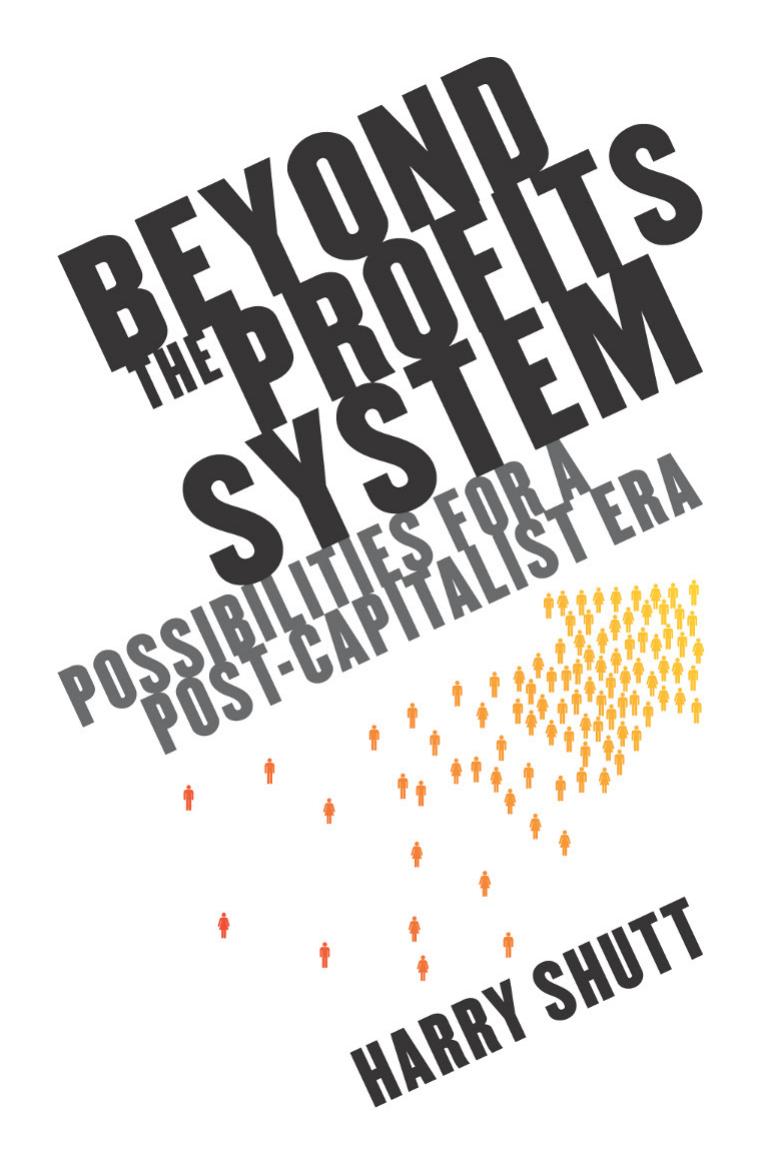
Author:Harry Shutt
Language: eng
Format: epub, pdf
Publisher: Zed Books
Published: 2013-03-14T16:00:00+00:00
5
A new model: ending the tyranny of production
THE INSISTENCE of policymakers in the post-World War II world on making the maximisation of economic growth, as reflected in GDP, the supreme public good in the economic sphere has long been accepted more or less without question by economists and political parties alike. However, as argued in the last two chapters, there are by now compelling reasons for seeing the end of this prioritisation of growth – along with the demise of an enterprise sector driven by profit maximisation – as inevitable.
Such a momentous development in our economic evolution makes it necessary to reconsider the relevance of this supposed indicator of national and global prosperity – which effectively equates prosperity with expanding production as rapidly as possible. In seeking for an alternative to this treadmill of growth and profit maximisation it will be necessary to re-examine some generally held assumptions about the ultimate purpose of economic policy, capitalist or otherwise. These assumptions, it is here suggested, are centred on an implicit belief in the desirability of maximising output which long pre-dates World War II – even though the very concept of GDP, let alone the idea of targeting or maximising its growth, did not exist until the 1930s.
Origins of the expansionist bias
In fact it seems quite natural that there should be a bias in favour of increasing output in any given society. Arguably that is because (a) under traditional economic conditions (before the technological breakthroughs brought about by the agricultural and industrial revolutions of the eighteenth and nineteenth centuries) relative scarcity of commodities was the normal state of affairs in every country; and (b) commercial opportunism would naturally dispose suppliers of goods and services to view increasing output as likely to enhance their living standards and economic security. At the same time governments readily understood the correlation between the level of activity in sectors of the economy which tended to generate most tax revenues and the state of the public finances in an era when preoccupation with the latter – along with concern to protect national trading interests from foreign competition – effectively defined the entire scope of economic policy. This tendency was also linked to a view of international relations (known as mercantilism) which put a premium on maximising exports and minimising imports as a way of assuring a nation’s relative economic and military strength vis-à-vis others. Such was broadly the stance of the industrialised countries until about the time of World War I, whereafter extension of the franchise and the consequent creation of welfare states meant that unemployment and social issues became matters of policy concern for the first time.
In terms of the evolution of classical economic theory the most robust expression of this tendency to favour higher output is arguably the so-called ‘labour theory of value’ as formulated by Ricardo. This theory, according to which the value of a commodity is determined by the amount (and value) of labour used to produce it, is evidently a reformulation of the
Download
This site does not store any files on its server. We only index and link to content provided by other sites. Please contact the content providers to delete copyright contents if any and email us, we'll remove relevant links or contents immediately.
International Integration of the Brazilian Economy by Elias C. Grivoyannis(111103)
The Radium Girls by Kate Moore(12045)
Turbulence by E. J. Noyes(8062)
Nudge - Improving Decisions about Health, Wealth, and Happiness by Thaler Sunstein(7717)
The Black Swan by Nassim Nicholas Taleb(7145)
Rich Dad Poor Dad by Robert T. Kiyosaki(6655)
Pioneering Portfolio Management by David F. Swensen(6311)
Man-made Catastrophes and Risk Information Concealment by Dmitry Chernov & Didier Sornette(6049)
Zero to One by Peter Thiel(5818)
Secrecy World by Jake Bernstein(4763)
Millionaire: The Philanderer, Gambler, and Duelist Who Invented Modern Finance by Janet Gleeson(4492)
The Age of Surveillance Capitalism by Shoshana Zuboff(4315)
Skin in the Game by Nassim Nicholas Taleb(4265)
The Money Culture by Michael Lewis(4218)
Bullshit Jobs by David Graeber(4204)
Skin in the Game: Hidden Asymmetries in Daily Life by Nassim Nicholas Taleb(4021)
The Dhandho Investor by Mohnish Pabrai(3780)
The Wisdom of Finance by Mihir Desai(3757)
Blockchain Basics by Daniel Drescher(3592)
